
St Andrew’s Cathedral School’s approach to learning.
At St Andrew’s Cathedral School, we believe learning is deeply personal. Every student arrives with different strengths, challenges, ambitions and experiences, and we see it as our responsibility to help each young person grow with confidence and purpose. Therefore, our focus is on our students’ progress rather than attainment alone – giving equal attention to high-potential students, students with specialised learning needs and every learner in between.
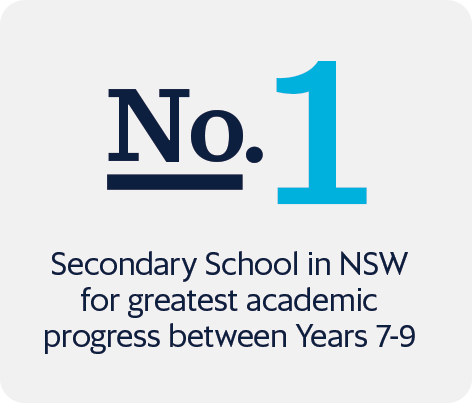
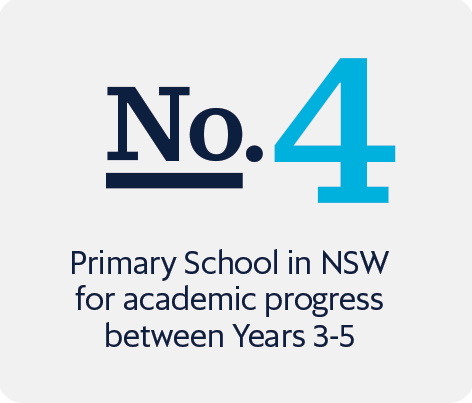
This month, we were delighted to be recognised as the Secondary School in NSW showing the greatest academic progress between Years 7 and 9, and fourth across all Primary Schools in NSW for progress between Years 3 and 5, based on NAPLAN data from 2023–2025.
Strong growth continues through to High School
While NAPLAN captures only one part of a student’s educational journey, these results affirm something we see every day in our classrooms: students at St Andrew’s are learning deeply, growing consistently and being supported to achieve their personal best. This strong progress continues through the senior years, reflected in the outstanding outcomes our students achieve in both the HSC and the IB Diploma.




One way of measuring these outcomes across both pathways is through the ATAR, noting that IB Diploma results receive an ATAR equivalency rather than an ATAR itself. The table below shows the percentage of students achieving within each ATAR band over the past four years.
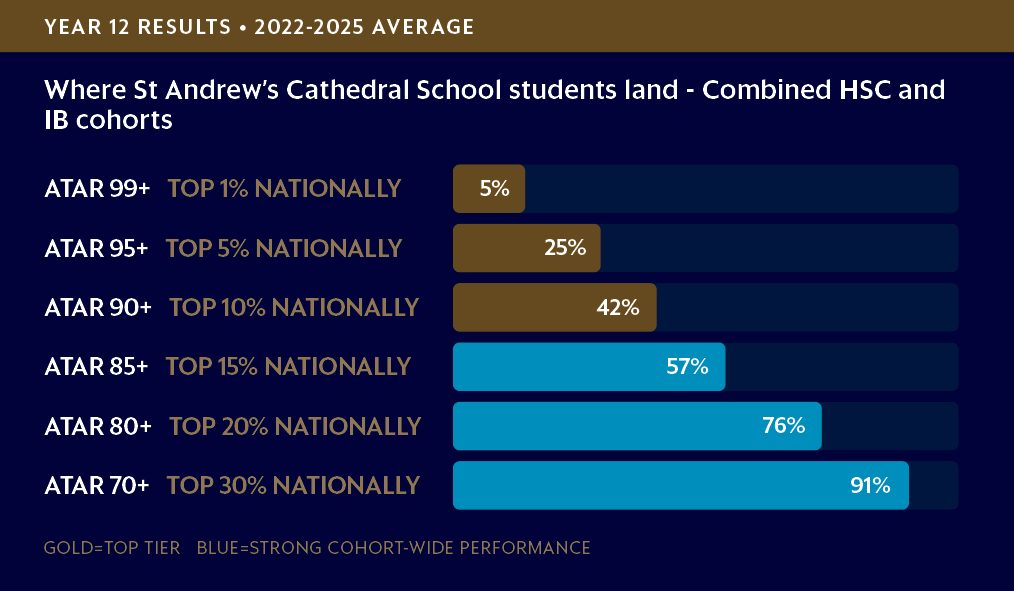
Continuing the theme of progress, what is particularly exciting is the growth of the whole school. When comparing the average results from the last four years with those from the previous four years, St Andrew’s has made strong improvement across the board. Everyone making great progress—that is the goal.
What makes progress such an important measure is that it recognises growth. Attainment alone can sometimes reflect where students started; progress reflects the impact of teaching, support, effort and learning over time. It tells the story of students developing knowledge, confidence and capability.
A research-informed approach to learning
That story has been shaped over many years through a deliberate and research-informed approach to teaching and learning.
In 2017, St Andrew’s Cathedral School began developing a teaching and learning model grounded in cognitive science. Current Head of School, Dr Julie McGonigle, joined the School that year on a secondment from the UK. She began working closely with Professor John Sweller at UNSW to explore how Cognitive Load Theory and neuroscience could better inform classroom practice.
“From this partnership grew a K-12 approach centred on explicit teaching, carefully sequenced learning and the development of strong disciplinary knowledge.”
“From this partnership grew a K-12 approach centred on explicit teaching, carefully sequenced learning and the development of strong disciplinary knowledge as the foundation for deeper thinking and expertise,” said Dr McGonigle.
A focus on professional growth
At the same time, the School strengthened its culture of professional growth through regular lesson observation, coaching and rich professional learning opportunities, led by Deputy Head of Teaching and Learning, Dr Kirsten Macaulay. This collaborative culture has enabled teachers to continually refine their practice and learn from one another.

In 2022, the School expanded this work through the introduction of a consistent approach to teaching writing across multiple subject areas, under the leadership of Deputy Head of School, Brad Swibel. Inspired by Judith Hochman and Natalie Wexler’s The Writing Revolution, the initiative aimed to give students a shared framework for analytical writing that could be applied confidently across disciplines.
“We saw the need for developing an explicit and interdisciplinary approach to teaching writing as the impacts of technology became evident within students’ work over the last decade.”
“We saw the need for developing an explicit and interdisciplinary approach to teaching writing as the impacts of technology became evident within students’ work over the last decade,” said Mr Swibel.
Teachers across faculties collaborated to create common approaches to sentence construction, paragraph structure and disciplinary vocabulary, while still honouring the unique writing demands of each subject. The result has been stronger communication skills, sharper analytical thinking and greater confidence in student writing.
Introducing a Learning Skills programme
Most recently, in 2024, the School introduced a Learning Skills programme developed by Director of Academic Progress, Ms Estee Stephenson. The programme teaches students how learning itself works – drawing on evidence from cognitive science to help students build effective study habits, memory strategies and independent learning skills. Importantly, parents have also been invited into the process, enabling families to better support learning at home and engage with the evidence-based practices being used at school.
A belief that every student can grow
What sits behind all of this is not a single programme or initiative, but a shared commitment: a belief that every student can grow, and that great teaching changes lives.
At St Andrew’s Cathedral School, academic progress is ultimately about people. It is about teachers who care deeply about their students – students who are encouraged to persevere and aim high, and families who partner with the School in the journey of learning. These results are encouraging, but what matters most is the confidence, curiosity and sense of possibility our students carry with them as they continue to grow – both in school and beyond.


