What’s the best part about going to St Andrew’s Cathedral School for you?
I think one thing I really love is the student engagement, with the School and each other. For example, I think a shining example of this is MakeOff.
In previous years, when I was helping out, I never felt alone or estranged despite not really knowing the other people in my house. This year, when we needed some extra manpower finishing our stall, people from other houses all came to help us after finishing their own stalls.
“I really love how despite the House competition, collaboration for the greater good came first.”
I really love how despite the House competition, collaboration for the greater good came first.
What’s your favourite subject and why? Any highlights?
I have to say that my two favourite subjects are Design Technology (DT) and Philosophy.
Design appeals to one of my personal core values, empathy. It’s fundamentally about identifying real human problems and helping them solve problems.
However, Philosophy has been crucial for helping me understand what others think and the world in general. It’s not just abstract ideas, but how they have been used in different contexts, their implications and assumptions that matter. Even beyond the realm of pure logicality, it’s helped me clarify my own convictions and how they shape what I believe in other areas of life.
You are now Design Captain. What does that involve? When did you start to develop your leadership skills at St Andrew’s Cathedral School?
As Technological and Applied Studies (TAS) Captain, I try to support people in the design space wherever I can — whether that’s helping out in Makerspace on Friday afternoons or sharing resources I’ve found useful myself.
I’ve also worked to make things a bit easier for future captains, helping open communication with IT around design software issues.
“For me, leadership is mostly about being useful, approachable and making sure other people can get the most out of the space.”
My earlier roles in Peer Support and Project Catalyst taught me a lot about how to work with younger students, which definitely helps when mentoring in Makerspace. For me, leadership is mostly about being useful, approachable and making sure other people can get the most out of the space.
Did you bring any particular skills to senior studies from undertaking the MYP in Middle School?
Some skills from the MYP have definitely been useful. For example, Philosophy and DT hand-in tasks remain fundamentally similar throughout MYP and IB – not only is the process similar, but you have to get started early!
The MYP’s freedom in exploring our own interests through the Personal Project and other smaller in-class tasks also prepared me to some extent for the IB, where there is definitely a focus on self-directed learning.
What teachers have most inspired you?
All my teachers have been magnificent, but if I had to choose one teacher that has left a lasting impact on me, it would be Mrs. Stephenson.
She’s an expert in educational research and always engages with the latest research on learning and performance — something she actively shares across the School. Her guidance has been critical in helping me develop executive functioning and learning strategies I now depend on – and not just in the classroom!
Do you have a few lasting memories of St Andrew’s Cathedral School or a story you’d like to share?
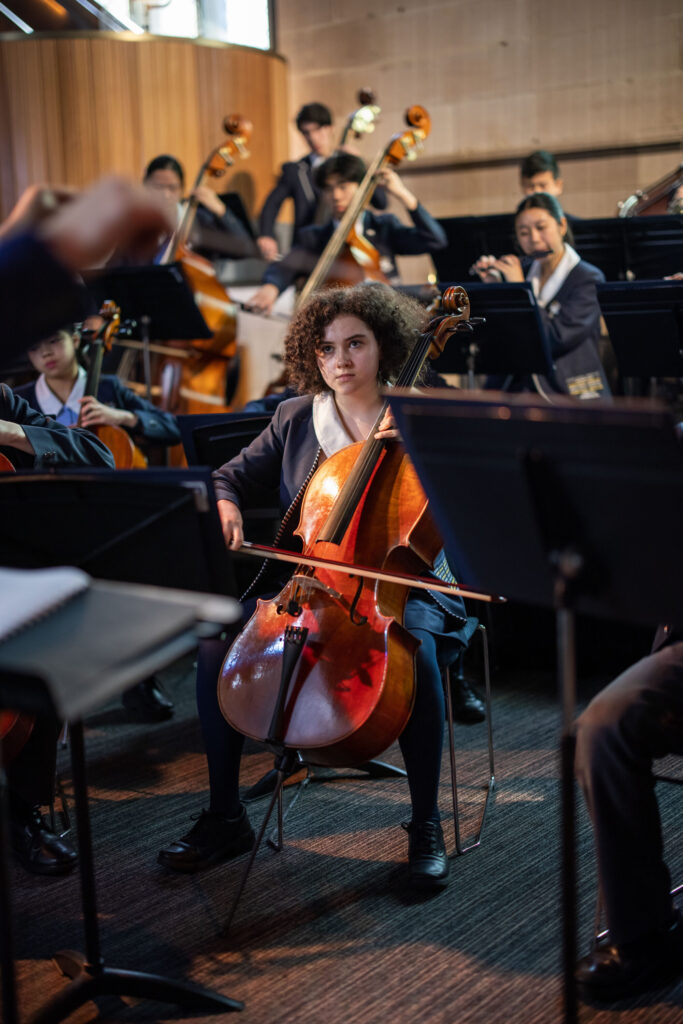
One of my favourite memories from my time at St Andrew’s Cathedral School is performing in Symphony Orchestra. A moment that really stood out was when we surprised Dr. Watson by playing Happy Birthday during Showcase, to celebrate his service to the School. Keeping it a secret as an ensemble and then pulling it off together made it feel like a shared accomplishment, and I think what I’ll remember most in years to come is the joy of performing incredible music with others and the feeling of community that came with it.
“I think what I’ll remember most in years to come is the joy of performing incredible music with others and the feeling of community that came with it.”
What do you hope to do next year and in your future?
I plan to study Product Design at university, because it is creative yet practical and leaves open the variety of things I might choose to design.
Eventually, I’d like to be able to work in a design firm focusing on making high-quality, thoughtful products, particularly those that work towards increasing human wellbeing.
Along the way, I’d like to keep developing all sorts of skills – I’d love to continue to develop my knowledge of philosophy, learn how to play a more portable instrument or learn to sing as well as playing the cello, or improving my language skills.